
CN300 Small Cannon Laser Edge Banding Machine
The CN300 rail with a laser unit between the glue station and the pressing: the heat lamp and PUR pot cover glued band, the laser bonds the functional layer without a glue line, and the same disc, scrapers and 35° ends finish both.
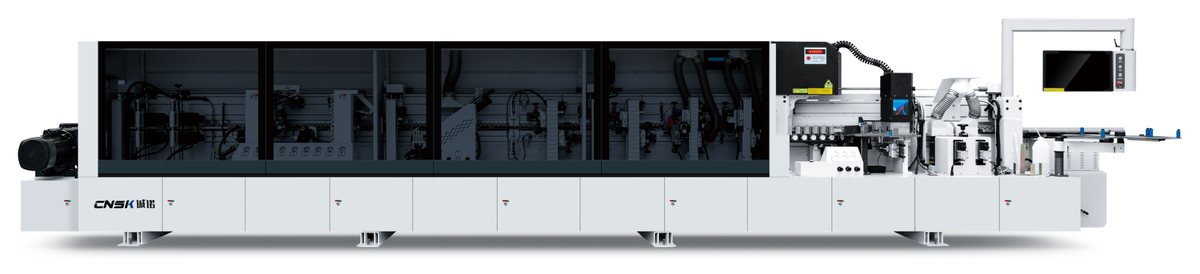
Overview
- Eighteen cells in the order printed on the sheet: 21.5-inch industrial computer, high-pressure beam on a heavy steel rail, separating agent, pre-milling, heat lamp, two-colour PUR no-cleaning pot, laser operating system, laser cooling system, swing-type pressing, double-stack disc trimming, scraping 1, scraping 2, hinged flat scraping, 35° end and tail trimming, four-head tracking, cleaning, polishing 1 and polishing 2.
- The laser unit sits at station 07 with its cooling head directly behind it, ahead of the pressing, so both glued and laser band run through the same trim and finish.
- Two extra cells over the standard CN300: the laser operating system and the cooling system.
- Panels from 40 mm wide and 8 to 60 mm thick, band 0.4 to 3 mm thick and 12 to 65 mm wide.
- 16 to 23 m/min on a 9,400 mm frame, 950 mm wide and 1,800 mm high, with 22 kW installed.
- The data sheet names this build Chengnuo Laser CN300 Small Cannon; the model cell still reads CN300, so the page carries CN300 LASER to keep the two apart.
- Disc trimming, the two scraping heads, the hinged flat scraper and the 35° ends are unchanged from the standard build.
Station sequence
Station 01 is the 21.5-inch computer and station 02 the high-pressure beam on its rail; the laser unit is station 07 and its cooling system station 08, in the order printed on the sheet.
Technical data
| Model | CN300 LASER |
| Feed rate | 16 – 23 m/min |
| Panel width | ≥ 40 mm |
| Panel thickness | 8 – 60 mm |
| Edge band thickness | 0.4 – 3 mm |
| Edge band width | 12 – 65 mm |
| Pressure beam | Heavy-duty high-pressure beam, electric lift |
| Processing stations | 18 |
| Control screen | 21.5-inch industrial computer |
| Input voltage | 380 V |
| Air pressure | 0.7 MPa |
| Total power | 22 kW |
| Machine size (L × W × H) | 9400 × 950 × 1800 mm |
Values from the Chengnuo Laser CN300 technical data sheet in the 2026 configuration list. That sheet prints the model as CN300 and names the build Chengnuo Laser CN300 Small Cannon; the page carries CN300 LASER as the model designation and Small Cannon Laser Edge Banding Machine as the equipment name.
What the machine is built to do
- Laser between glue and pressThe laser head and its cooler sit at stations 07 and 08, so a glued edge and a laser edge leave on the same settings.
- Heat lamp and PUR potThe lamp pre-heats the board and the glue, and the two-colour pot switches adhesive without a solvent flush.
- High-pressure beam on a railThe beam is a custom heavy section on a steel rail, sized for a 60 mm door blank.
- Double-stack disc trimmingTwo discs trim top and bottom in one pass, so the laser joint is cut square rather than scraped down.
- 35° end trimmingThe end heads cut at 35° and back off on a thicker board, which keeps the corner of a lacquered door intact.
- Two polishing headsPolishing 1 and 2 close the line, so a glue-free joint gets the same finish as a glued one.
More from the CN series
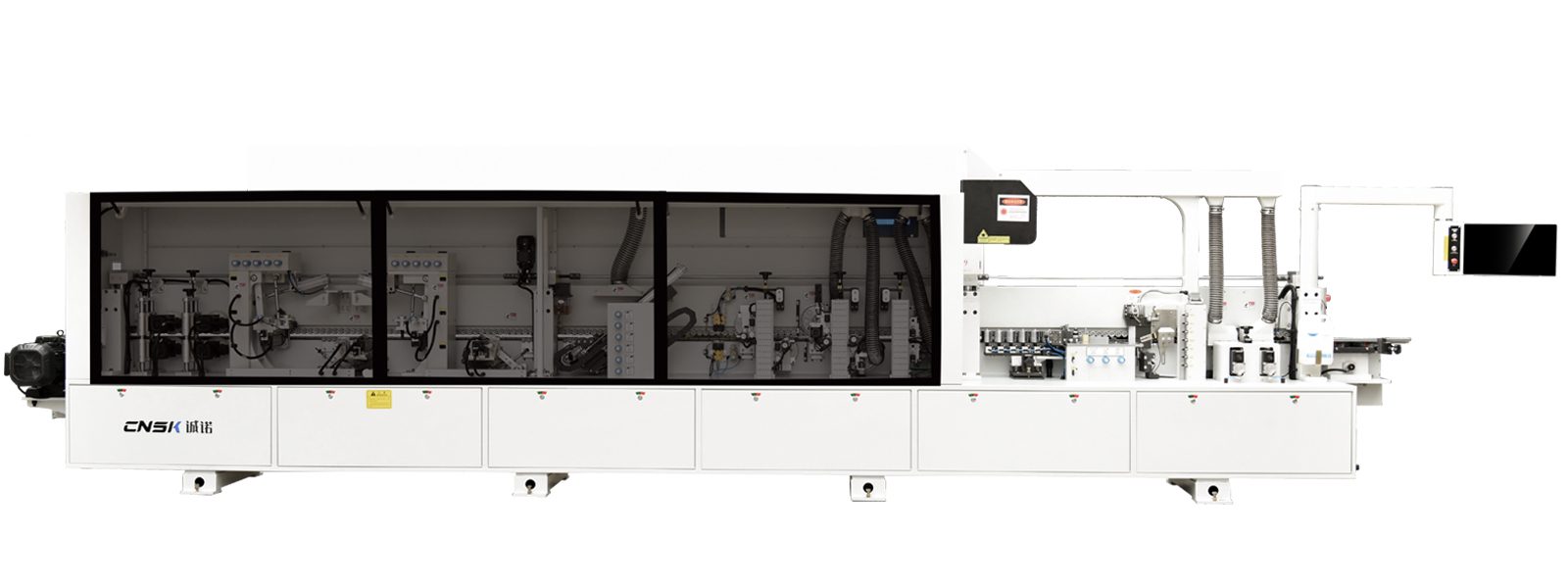
Servo Heavy-Duty Laser Edge Bander
Laser bonding with no glue line, on panels from 8 mm and strips down to 40 mm.
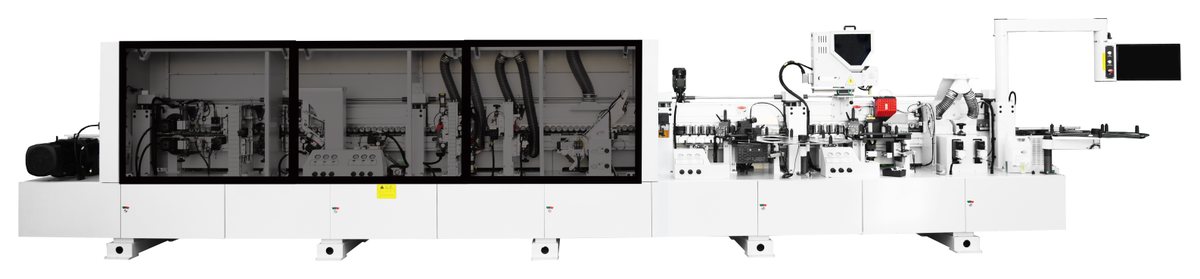
Automatic edge banding machine
Seventeen cells with two heat lamps, two glue stations and two pressing groups, servo fine trimming, 26.4 kW.
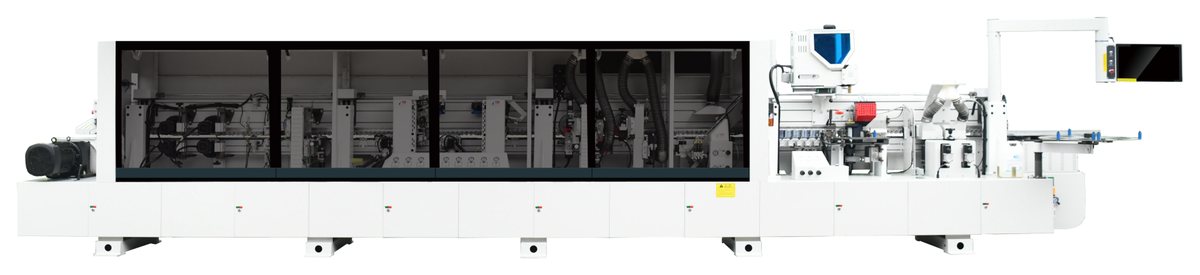
Servo Narrow Edge Automatic Edge Bander
Fourteen cells for narrow stock from 40 mm: EVA furnace, fast-melt tank, servo fine trimming, four-head tracking.
Put CN300 LASER against your panel.
Send the thickness, width and band you run. You get a station list, the tooling and a price against your name.