
Narrow-Panel Edge Bander with Twin Scraping
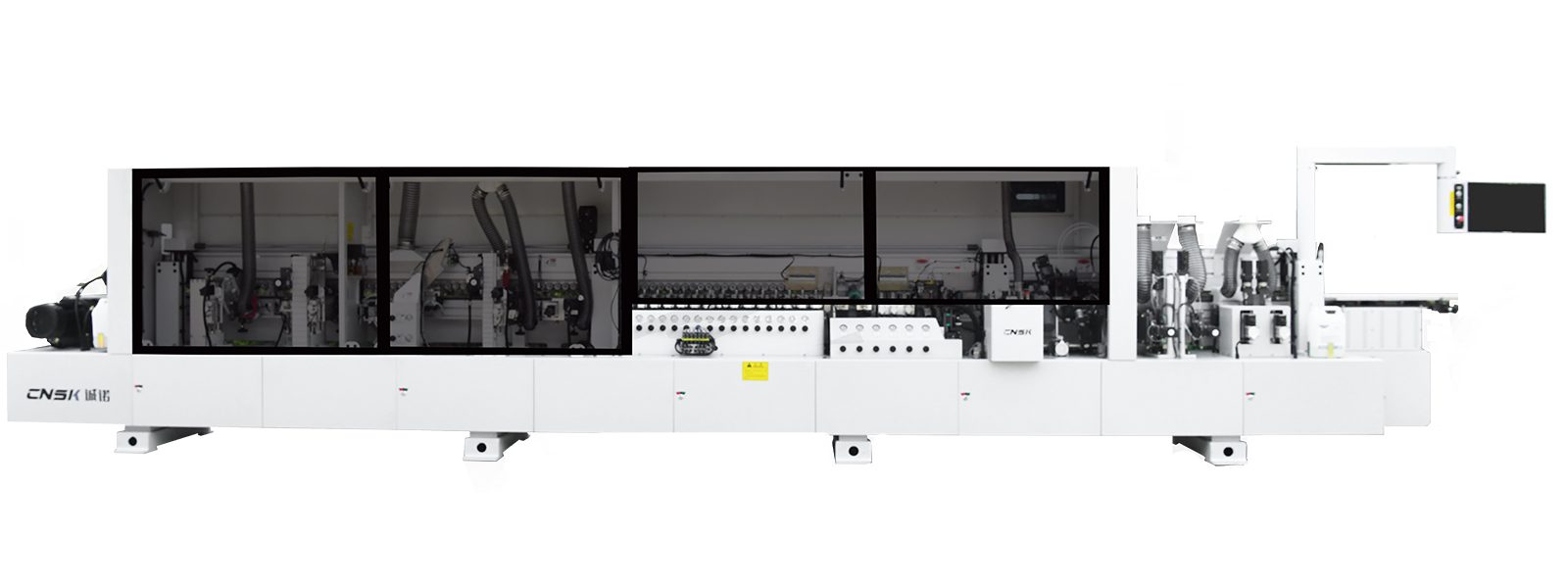
Twenty cells on a narrow-panel frame: the extra stations are the ones that show on the joint — a second scraping head and a second polishing pair, not another control box.
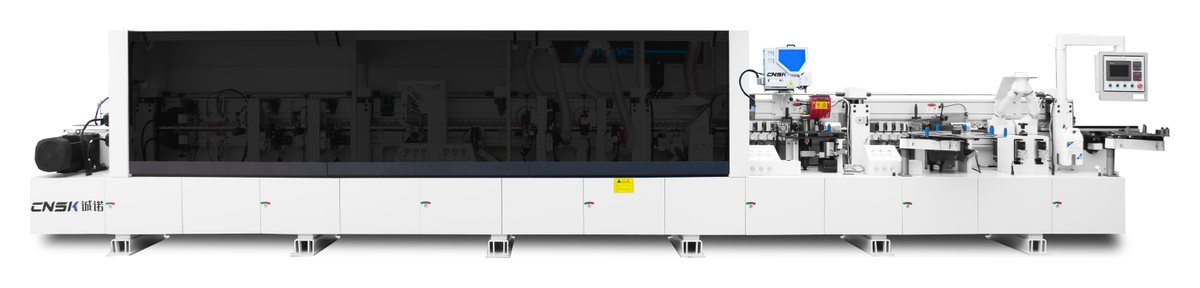
Overview
- Twenty numbered cells: 21.5-inch industrial computer, separating agent, pre-milling, heat lamp 1, glue applicator, pressing group 1, heat lamp 2, gluing furnace, fast-melt tank, pressing group 2, head-and-tail trimming, rough trimming, fine trimming, head tracking, scraping 1, scraping 2, precise flat scraping, cleaning, double polishing 1 and double polishing 2.
- Two heat lamps over two glue systems, an EVA furnace with a fast-melt tank, and a pressing group after each: the melt is at temperature at the start of the shift instead of half an hour into it.
- Rough trimming and fine trimming are separate stations here, so the allowance and the finishing cut are set independently.
- Two scraping stations follow head tracking: the first takes the trim marks and the second the film the first leaves.
- Panels from 50 mm wide and 9 to 60 mm thick, band 0.4 to 3 mm thick and 12 to 65 mm wide, 16 to 23 m/min, 21.5 kW.
- Double polishing is two stations, not one head run twice, so the edge leaves the line finished.
- 9,070 mm frame, 850 mm wide, 1,800 mm high, with the pressure beam on electric lift.
Station sequence
Station 01 is the 21.5-inch industrial computer; twenty numbered cells run from separating agent to the second polishing station.
Technical data
| Model | FM708JAS |
| Feed rate | 16 – 23 m/min |
| Panel width | ≥ 50 mm |
| Panel thickness | 9 – 60 mm |
| Edge band thickness | 0.4 – 3 mm |
| Edge band width | 12 – 65 mm |
| Pressure beam | Electric lift |
| Processing stations | 20 |
| Control screen | 21.5-inch industrial computer |
| Input voltage | 380 V |
| Air pressure | 0.7 MPa |
| Total power | 21.5 kW |
| Machine size (L × W × H) | 9070 × 850 × 1800 mm |
Values from the FM708JAS technical data sheet in the 2026 configuration list.
What the machine is built to do
- Twenty cells, no fillerThe additions over the sixteen-station build are a second scraping head and a second polishing pair, plus a separate rough and fine trim: each one is visible on the finished edge.
- EVA furnace and fast-melt tankA cold start does not hold the line: the melt reaches working temperature quickly and holds it through the shift.
- Two lamps for two glue systemsHeat lamp, applicator, press, heat lamp, furnace, fast melt, press: neither glue system inherits the temperature setting of the other.
- Twin scrapingThe first head takes trim marks, the second the residual film, so the panel face behind the band is clean before the flat scraper reaches it.
- Two polishing stationsTwo pairs of cotton wheels, run in sequence, give a higher sheen than one pair given two passes.
- Narrow-panel geometryA 50 mm minimum width and an 850 mm bed: the machine is sized for the strip, not for a 1.2 m door.
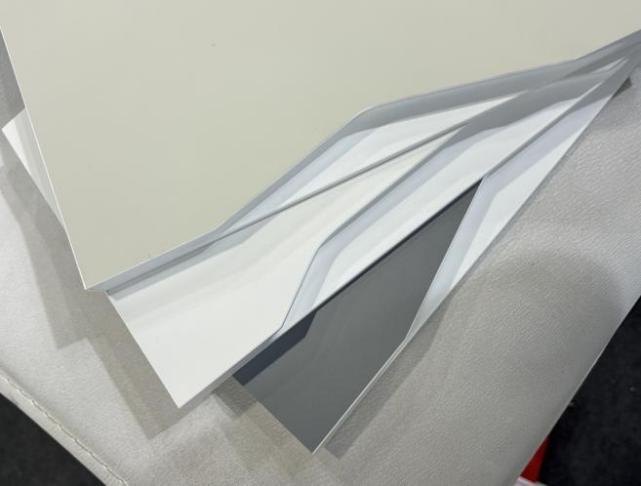
Edge samples
More from the 7 series
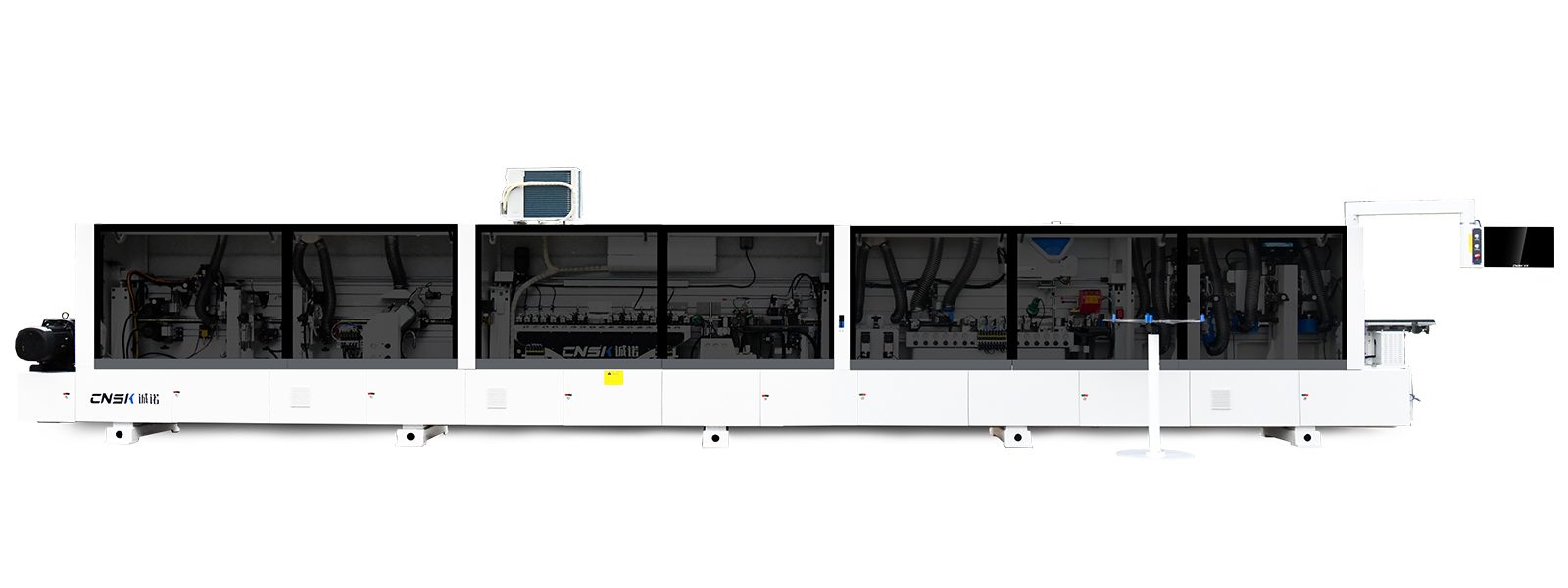
Double-Layer Handle-Free Edge Bander
Thirty handle-free profiles on one machine, switched from the screen with no waiting between shapes.
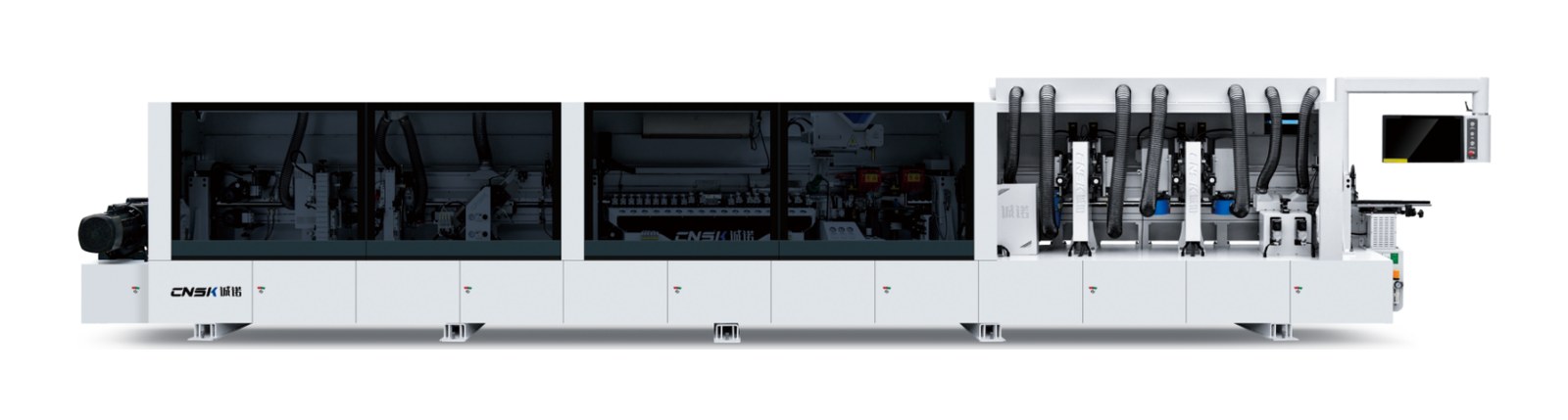
45° Bevel and Straight Edge Bander
The 45° bevel and the straight edge finished on the same line, plus soft-forming for wrapped profiles.
Five-Profile Arc and Bevel Edge Bander
Half-round, quarter-round, 45° bevel-straight, full bevel and duck-bill — five profiles on one bed.
Put FM708JAS against your panel.
Send the thickness, width and band you run. You get a station list, the tooling and a price against your name.