
Servo-Forming Special-Shaped Edge Bander
Soft-forming is a pressure problem before it is a cutting problem: seventeen servo pressing groups and four baking lamps hold a wrapped band on the profile until it stays there.
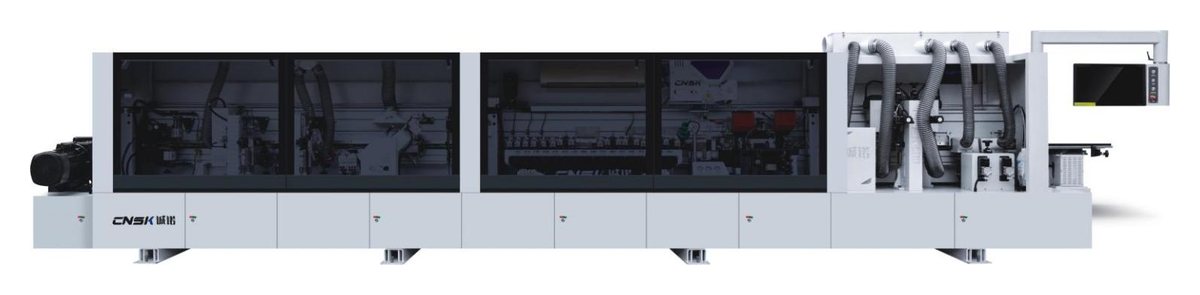
Overview
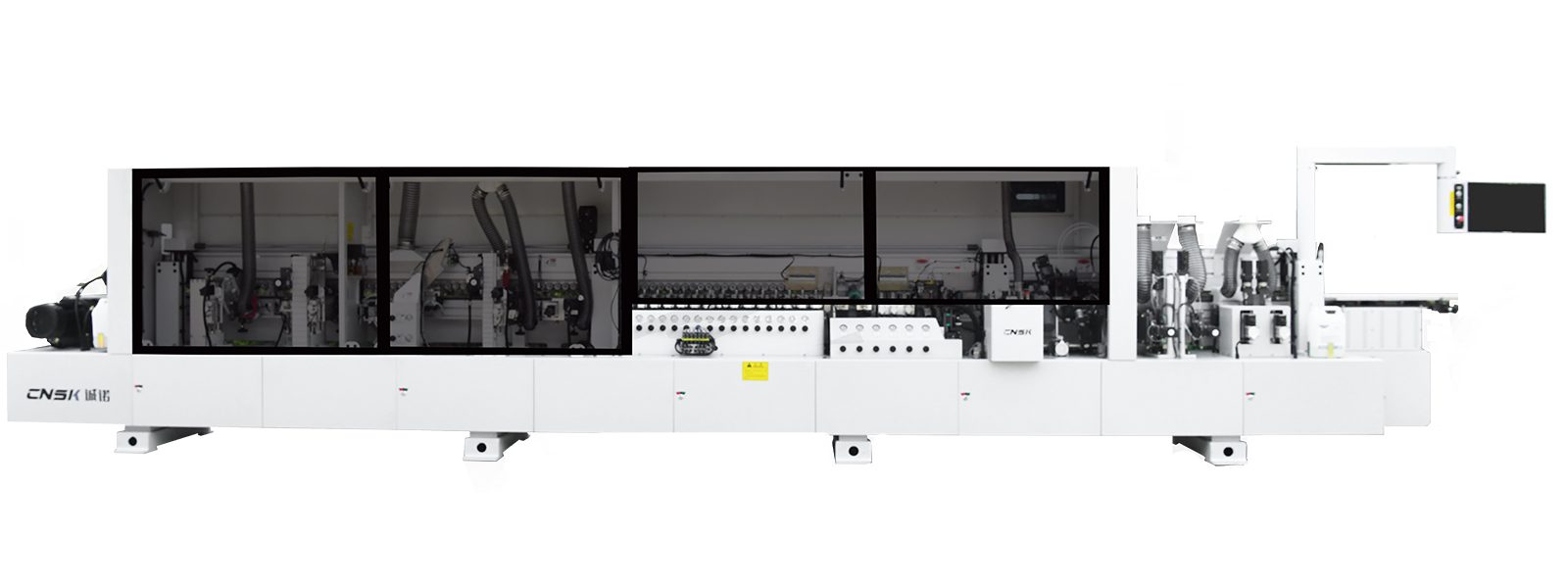
- Twenty numbered cells: 21.5-inch industrial computer, separating agent, pre-milling, servo forming cutter 1/2, bottom chamfer, panel preheating, gluing on the board surface, servo tape feed with notch and band gluing, fast-melt glue, transmission pressing, baking lamps 1 to 4, heat gun, seventeen-group servo forming and pressing, rough trimming, four-speed dual-track head-and-tail trimming, trimming, scraping, notch trimming, cleaning and servo polishing.
- The forming cutter is a servo pair on 7.5 kW spindles with more than twenty profile shapes held in the controller, so a wrap is milled rather than folded.
- Bottom chamfer follows the cutter: the lower edge is chamfered to the notch contour, which is what lets the band fold under the panel instead of lifting at the corner.
- Panel preheating, gluing on the board surface, servo tape feed and fast-melt glue, then transmission pressing: the band is fed, glued and pressed as a continuous web rather than as a cut length.
- Four baking lamps and a heat gun keep the band soft through the seventeen pressing groups, which is the section that decides whether a tight radius holds.
- Rough trimming, a four-speed dual-track end trim, trimming, scraping, notch trimming and servo polishing close the line.
- 5 m/min, 35 kW, 8,800 mm frame, 1,200 mm wide, 1,850 mm high, 4,000 kg: a slow, heavy line built for the profile rather than for throughput.
Station sequence
Station 01 is the 21.5-inch industrial computer; twenty numbered cells run from separating agent to servo polishing.
Technical data
| Model | FM730JC |
| Feed rate | 5 m/min |
| Panel width | ≥ 120 mm |
| Panel thickness | 18 – 25 mm |
| Edge band thickness | 0.5 – 0.7 mm |
| Edge band width | 30 – 65 mm |
| Pressure beam | Electric lift |
| Processing stations | 20 |
| Control screen | 21.5-inch industrial computer |
| Input voltage | 380 V |
| Air pressure | 0.7 MPa |
| Total power | 35 kW |
| Machine size (L × W × H) | 8800 × 1200 × 1850 mm |
Values from the FM730JC technical data sheet in the 2026 configuration list. The sheet also gives the edge type as special-shaped and the machine weight as 4,000 kg.
What the machine is built to do
- Servo forming cutterTwo spindles mill the profile groove with the shape called from the screen, so a change of profile does not wait for a tooling set.
- Seventeen pressing groupsSeventeen servo pressure components load the band along every curve, so a wrap closes without a second pass or a hand touch-up.
- Four baking lamps and a heat gunThe band is kept soft across the whole forming section, so a tight radius folds without a white stress line.
- Bottom chamferThe lower edge is chamfered to the notch contour, which is the detail that stops a wrap lifting at the corner.
- Transmission pressingA driven section carries the panel through the forming zone at constant speed, so the band is loaded for its full contact length.
- 5 m/minA forming line runs slowly on purpose: the band needs time under the lamps and under the press to take a shape and keep it.
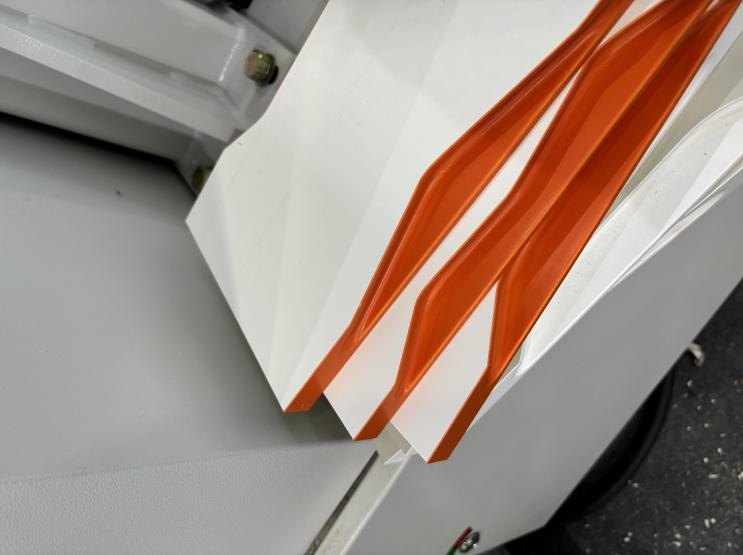
Edge samples
More from the 7 series
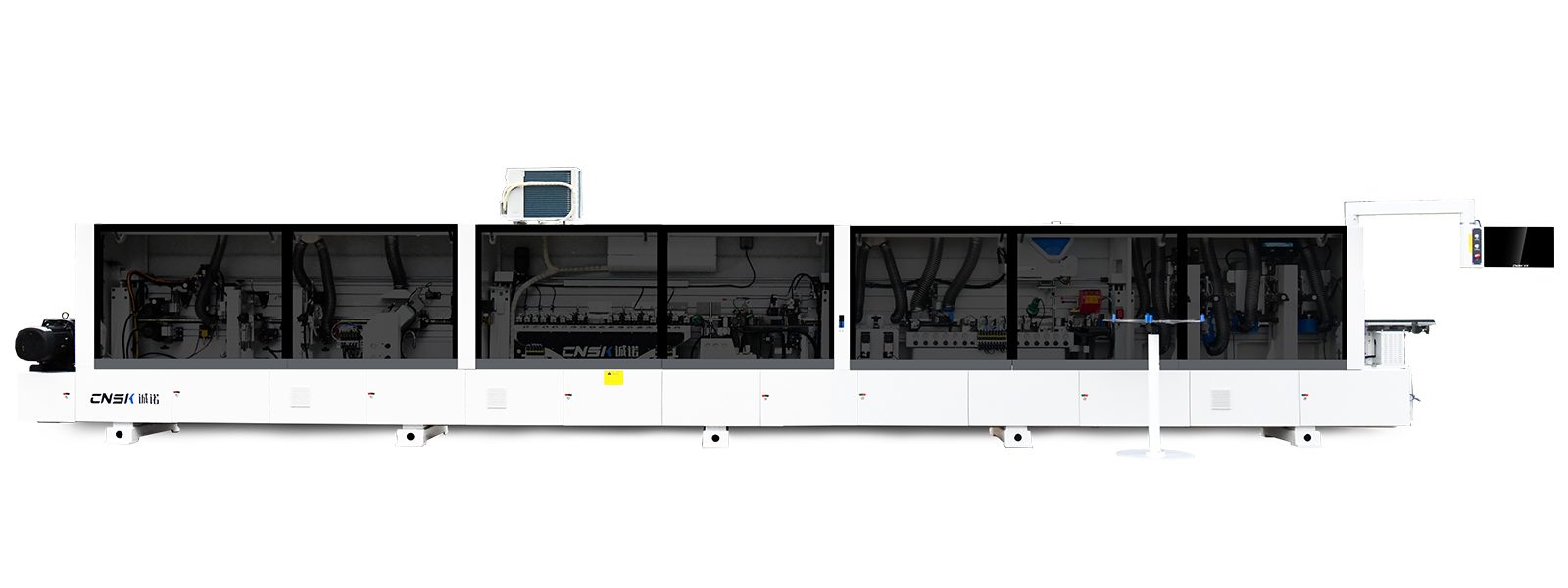
Double-Layer Handle-Free Edge Bander
Thirty handle-free profiles on one machine, switched from the screen with no waiting between shapes.
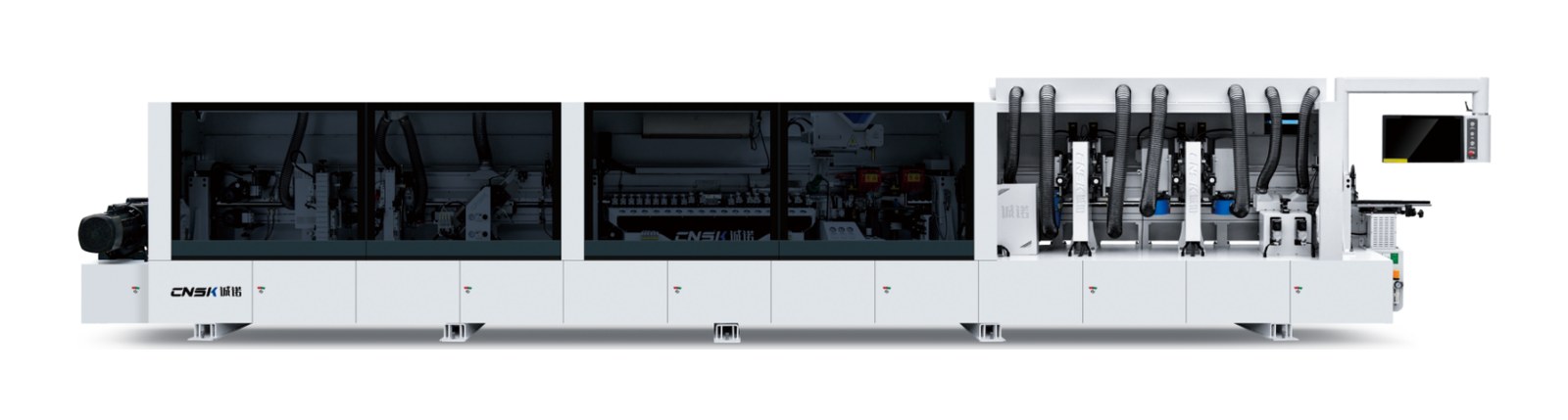
45° Bevel and Straight Edge Bander
The 45° bevel and the straight edge finished on the same line, plus soft-forming for wrapped profiles.
Five-Profile Arc and Bevel Edge Bander
Half-round, quarter-round, 45° bevel-straight, full bevel and duck-bill — five profiles on one bed.
Put FM730JC against your panel.
Send the thickness, width and band you run. You get a station list, the tooling and a price against your name.