
Soft-Forming Edge Bander with Track Conveyor
A track conveyor carries the panel through every cell at one speed, which is what a soft-formed wrap needs: the band is loaded for the same contact time on the first panel and the last.
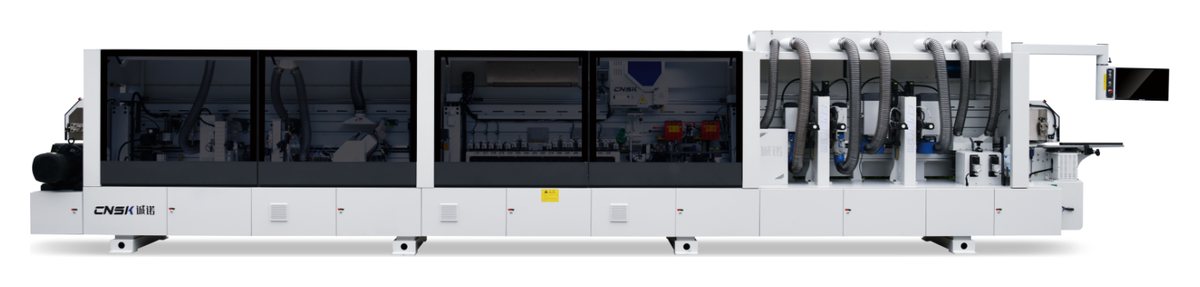
Overview
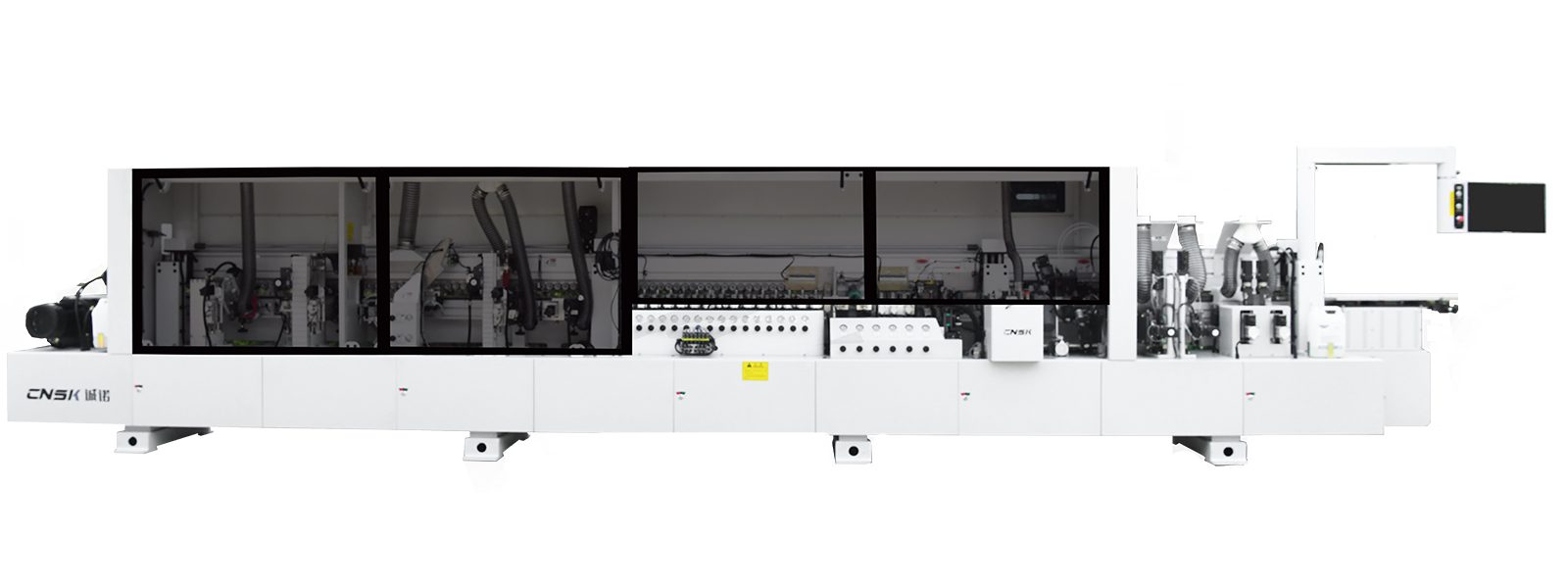
- Twenty numbered cells: 21.5-inch industrial computer, pre-milling, servo forming cutter 1/2, servo forming cutter 3/4, bottom chamfer, panel preheating, gluing on the board surface, servo tape feed with notch and band gluing, fast-melt glue, transmission pressing, baking lamps 1 to 4, heat gun, seventeen-group servo forming and pressing, rough trimming, four-speed dual-track head-and-tail trimming, fine trimming, scraping, notch trimming, cleaning and servo polishing.
- A track conveyor runs under the panel from the infeed; it is a frame feature and does not take a station number, so the screen is station 01 and the sequence has twenty numbered cells.
- Two servo cutter pairs mill the profile on both faces of the band, and bottom chamfer sets the lower edge to the notch contour before gluing.
- Gluing on the board surface, servo tape feed and fast-melt glue feed a transmission pressing section, so the band is laid and pressed as a continuous web.
- The track conveyor keeps the panel from drifting on a long wrap, which is the difference between a profile that closes and one that rides up at the corner.
- 9,985 mm frame, 1,200 mm wide, 1,850 mm high, 52 kW, 4,600 kg, at a single 8 m/min feed.
- Panels from 120 mm wide and 18 to 25 mm thick, band 0.5 to 0.7 mm thick and 30 to 65 mm wide.
Station sequence
Station 01 is the 21.5-inch industrial computer. The track conveyor is a frame feature and is not counted as a station, so the sequence has twenty numbered cells, from pre-milling to servo polishing.
Technical data
| Model | FM759GJC |
| Feed rate | 8 m/min |
| Panel width | ≥ 120 mm |
| Panel thickness | 18 – 25 mm |
| Edge band thickness | 0.5 – 0.7 mm |
| Edge band width | 30 – 65 mm |
| Pressure beam | Electric lift |
| Processing stations | 20 |
| Control screen | 21.5-inch industrial computer |
| Input voltage | 380 V |
| Air pressure | 0.7 MPa |
| Total power | 52 kW |
| Machine size (L × W × H) | 9985 × 1200 × 1850 mm |
Values from the FM759GJC technical data sheet in the 2026 configuration list. The sheet lists twenty-one positions, of which the second is the track conveyor; that position is a frame feature, so the station count is twenty. The sheet also gives the edge type as special-shaped and the machine weight as 4,600 kg.
What the machine is built to do
- Track conveyor on the infeedA crawler supports the panel and drives it at constant speed through every cell, so the contact time under the lamps and the press does not vary.
- Two servo cutter pairsThe profile is milled on both faces of the band, so a wrap is cut rather than folded onto a single groove.
- Bottom chamferThe lower edge is chamfered to the notch contour, which is the detail that stops a wrap lifting at the corner.
- Seventeen forming groupsPressure along the whole profile, with four baking lamps and a heat gun keeping the band soft into the press.
- Transmission pressingA driven pressing section carries the panel through the forming zone, so the band is loaded for its full contact length.
- 8 m/min, 52 kWA production rate for a soft-forming line, with the track conveyor holding the wrap steady at it.
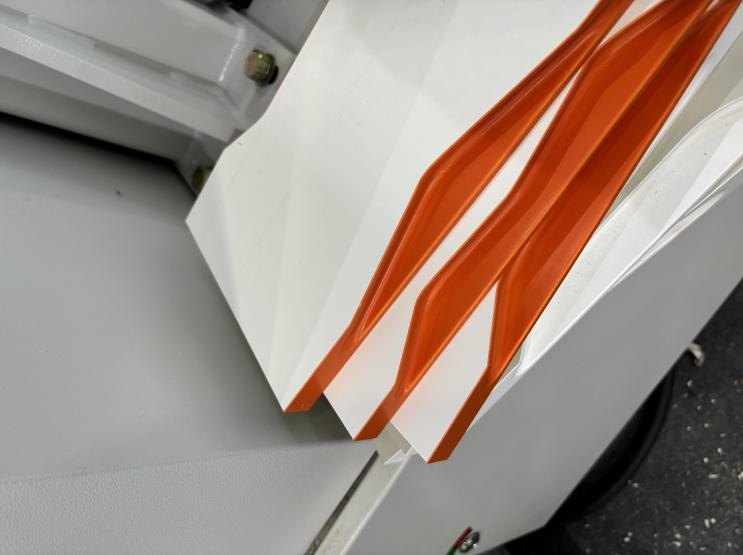
Edge samples
More from the 7 series
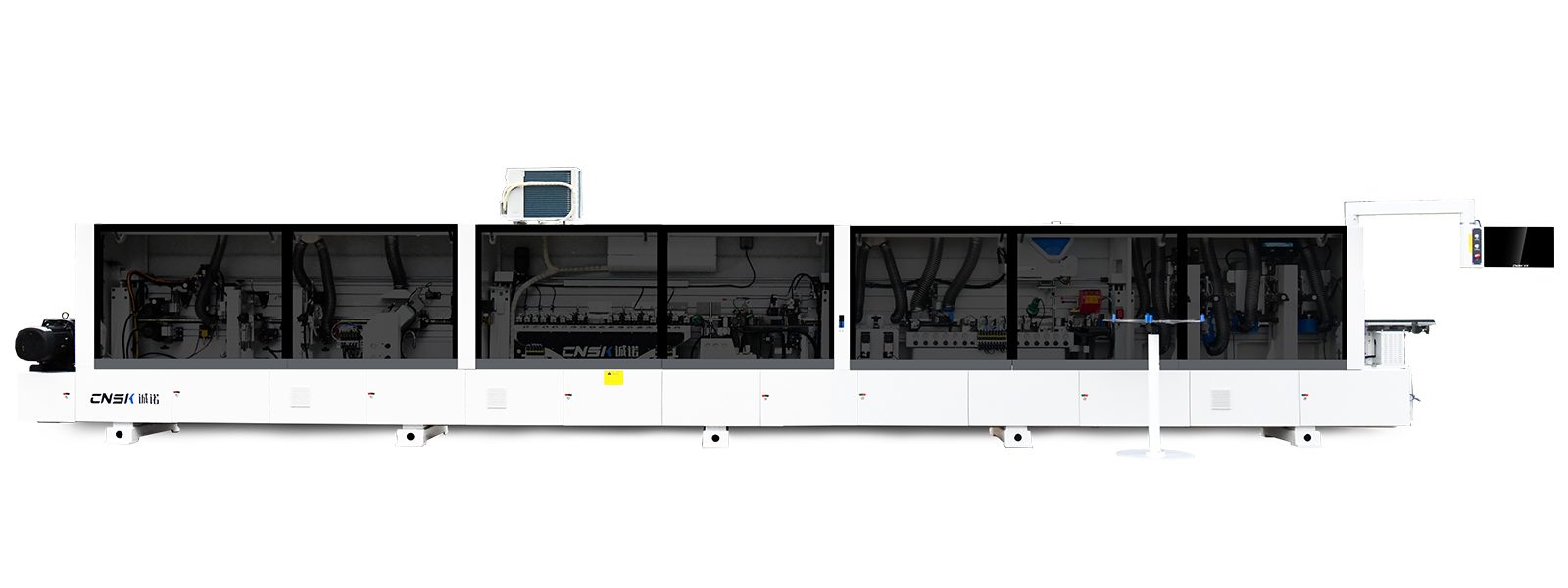
Double-Layer Handle-Free Edge Bander
Thirty handle-free profiles on one machine, switched from the screen with no waiting between shapes.
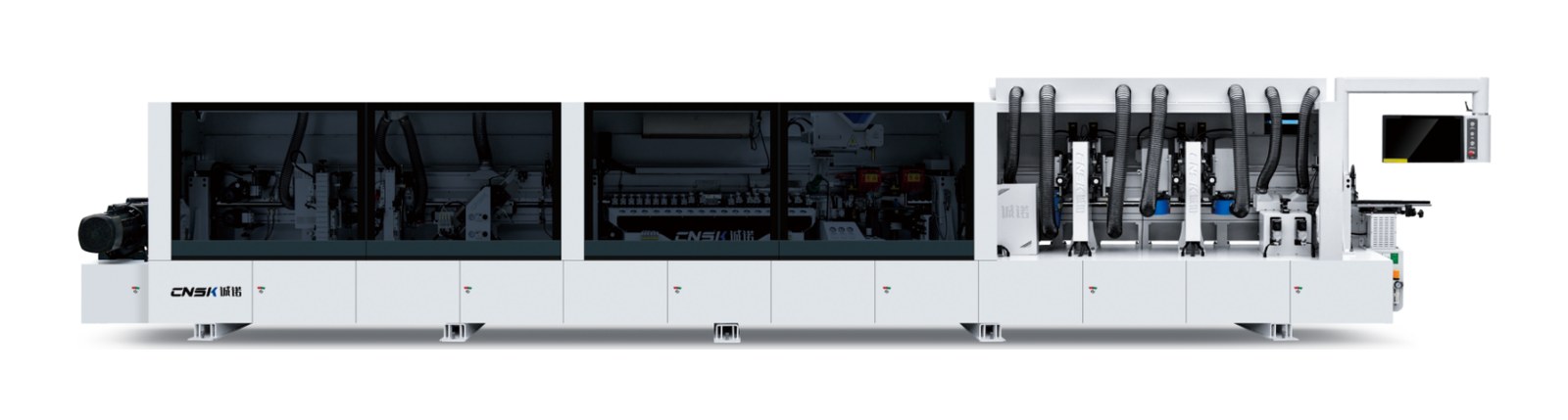
45° Bevel and Straight Edge Bander
The 45° bevel and the straight edge finished on the same line, plus soft-forming for wrapped profiles.
Five-Profile Arc and Bevel Edge Bander
Half-round, quarter-round, 45° bevel-straight, full bevel and duck-bill — five profiles on one bed.
Put FM759GJC against your panel.
Send the thickness, width and band you run. You get a station list, the tooling and a price against your name.