
FM368JS
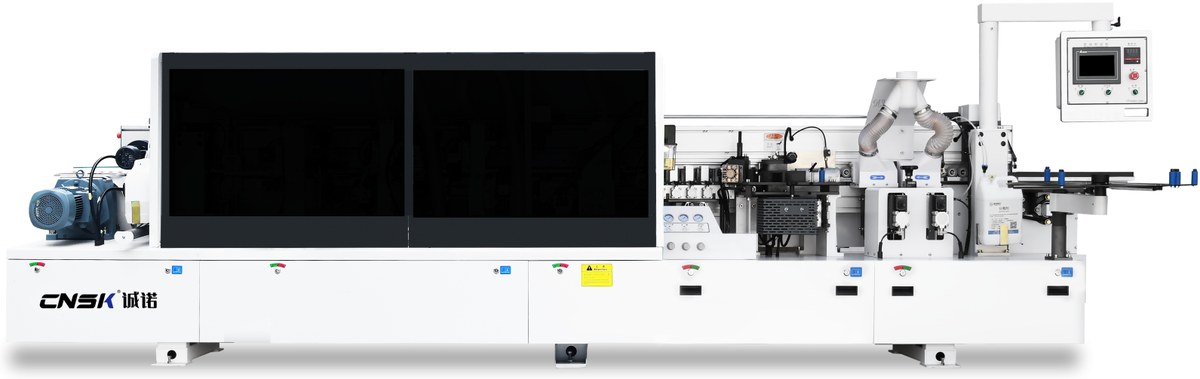
Track-Fed Straight Edge Bander with Notching
Track conveyor at the infeed, double end trimming and double scraping in the middle, notching at the outfeed — one pass on a 6,600 mm bed.
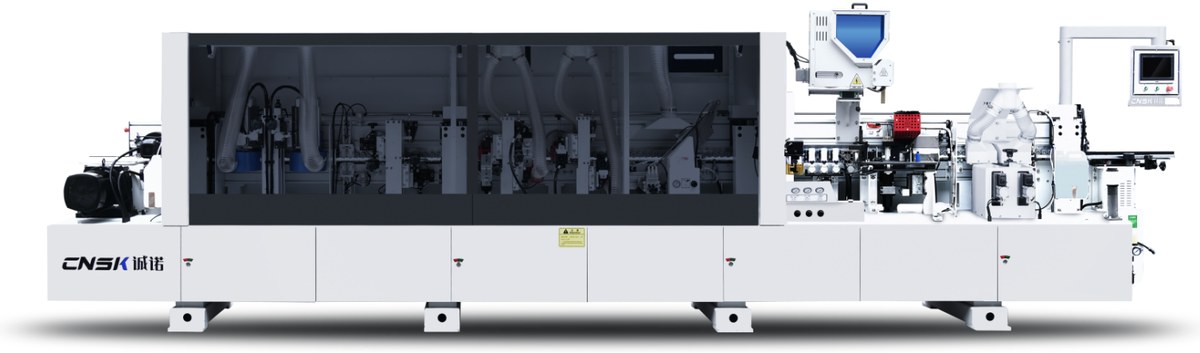
Overview
- Eleven processing cells: track conveyor, separating agent, pre-milling, gluing, pressing, double-track end trimming, rough and fine trimming, double-edge scraping, double polishing and notching.
- The crawler conveyor supports the panel and drives it at constant speed, which is what keeps a long or a thin part on line.
- Double-track end trimming and double-edge scraping work a pair of panels without slowing the feed.
- 12–40 mm panels, ≥ 50 mm width, 16–23 m/min; 6,600 mm bed.
- 18 kW total, 380 V, 0.7 MPa air.
FM368JS
CNSK · Dongguan
Feed rate16 – 23 m/min
Panel thickness12 – 40 mm
Panel width≥ 50 mm
Processing stations11
Total power18 kW
Station sequence
The panel enters on the track conveyor, then passes ten cells from the separating-agent spray to the notching unit.
01
Track conveyor
A crawler conveyor supports the panel and drives it through every cell at constant speed.
02
Control screen
Job set-up runs from the screen — parameters entered by touch or input box — and a change shows its effect at once.
03
Separating agent
A fine spray separates surplus glue from the panel face, so hot-melt does not mark the board after pressing.
04
Pre-milling
Two milling cutters re-finish the saw marks, burrs and out-of-square edges left by the panel saw, so the band seats on a clean face.
05
Gluing
Hot-melt adhesive is melted and applied to the panel edge before the band is pressed on.
06
Pressing
High-precision pressure wheels load the band evenly as it meets the panel, so the joint sits flat and holds.
07
Head-and-tail trimming, double track
Two tracks run the ends, so a pair of panels is trimmed without dropping the feed speed.
08
Rough trimming
The first trim brings the band's upper and lower edges down to the panel faces and leaves the allowance for the finishing head.
09
Fine trimming
The finishing cut takes the overhang back to the panel face; this is the pass that decides how clean the joint reads.
10
Double-edge scraping
Scraping on both edges of the run, for trim marks and surplus glue on either face.
11
Double polishing
Two sets of cotton wheels finish the edge, for a higher sheen on the joint than a single head gives.
12
Notching
A slotting unit cuts the notches the profile needs after banding, so a notched panel does not need a second machine.
Technical data
| Model | FM368JS |
| Feed rate | 16 – 23 m/min |
| Panel width | ≥ 50 mm |
| Panel thickness | 12 – 40 mm |
| Edge band thickness | 0.4 – 1.5 mm |
| Edge band width | 22 – 65 mm |
| Pressure beam | Electric lift |
| Processing stations | 11 |
| Control screen | Numeric panel or industrial touch screen, per configuration |
| Input voltage | 380 V |
| Air pressure | 0.7 MPa |
| Total power | 18 kW |
| Machine size (L × W × H) | 6600 × 800 × 1750 mm |
Values from the FM368JS technical file (its parameter table carries the model as FM386JS) and the 2026 configuration list.
What the machine is built to do
- Track conveyor infeedA crawler conveyor supports the panel and drives it at constant speed through every cell, which keeps long panels from drifting.
- Separating agentA fine spray separates surplus glue from the panel face, so hot-melt does not mark the board after pressing.
- Pre-milling before gluingTwo cutters take the saw marks and the out-of-square edge off the panel first, so the band meets a clean face instead of bridging a ripple.
- Notching on the lineThe slotting unit cuts the notches a profile panel needs after banding, so the part does not come off the line for a second operation.
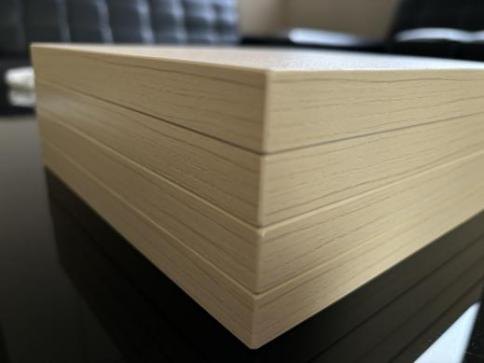
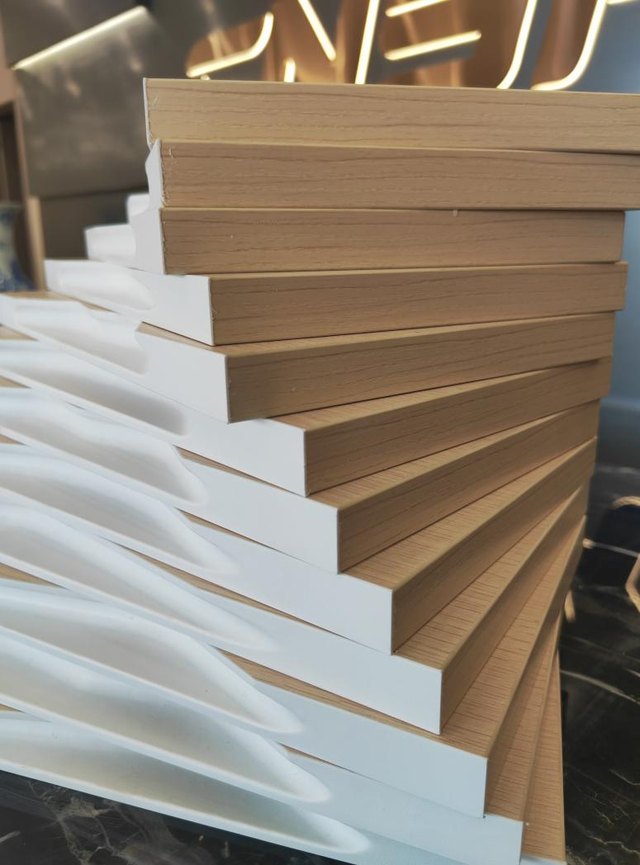
Edge samples
More from the 3 series
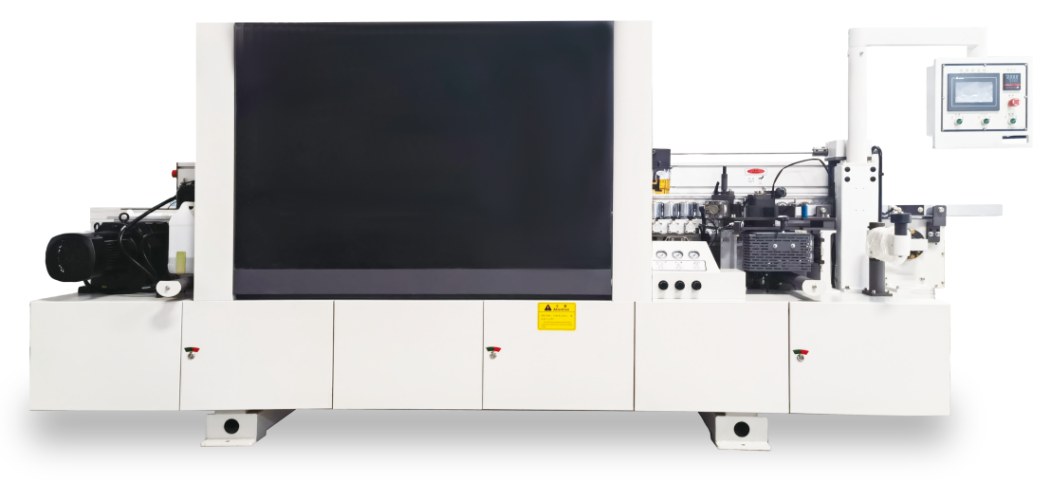
FM365
Straight Edge Bander
Seven stations on a four-metre bed: gluing, pressing, end trim, fine trim, scraping, cleaning and polishing on 9–60 mm straight panels.
7 stations9–60 mm16–23 m/min4 m bed
Read the specification
FM365J
Straight Edge Bander
Two glue positions and a separating-agent spray on a 5,600 mm bed.
9 stations9–60 mm16–23 m/min5.6 m bed
Read the specification

FM368
Straight Edge Bander
Rough and fine trimming as separate heads on a 4,700 mm bed.
8 stations9–60 mm16–23 m/min4.7 m bed
Read the specification
Put FM368JS against your panel.
Send the thickness, width and band you run. You get a station list, the tooling and a price against your name.