
Intelligent PUR track edge banding machine
A reverse-layout build: the stations are mirrored along the bed, so the machine can be loaded from the side a line already feeds from, with two PUR pots and heat lamps in the sequence.
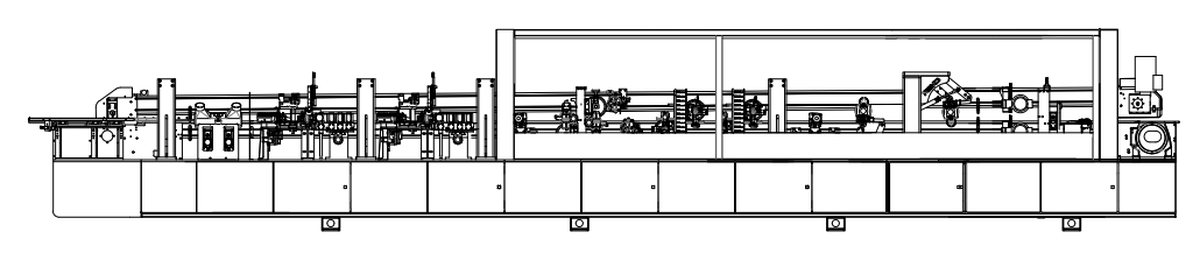
Overview
- Eighteen cells in the order printed on the sheet: 21.5-inch industrial computer, track conveyor, heavy-duty one-piece bed rail, separating agent, pre-milling, heat lamp, two-colour PUR pot, heat lamp, two-colour PUR pot, unpowered flush end trimming, powered edge trimming, unpowered trimming, scraping, double scraping, unpowered tail trimming, head tracking, polishing and notching.
- Reverse layout: the bed is mirrored, which is the build the Korean market orders when the machine has to sit at the end of an existing line rather than at its start.
- Two two-colour PUR pots with a heat lamp ahead of each, so a second adhesive colour is applied on a pre-heated face.
- Panels from 60 mm wide and 9 to 60 mm thick, band 0.4 to 3 mm thick and 12 to 65 mm wide.
- 16 to 26 m/min, the widest feed range in this group, on a 10,300 mm frame at 950 mm wide and 1,750 mm high.
- Trimming is a mix of powered and unpowered heads: the powered head sets the depth, the unpowered heads keep the cut clean with fewer wearing parts.
- Notching at station 18 lets a slotted part come off the line finished.
Station sequence
Station 01 is the 21.5-inch computer and station 02 the track conveyor; this page follows the sheet order of the reverse build, in which the two PUR pots sit at stations 07 and 09.
Technical data
| Model | FMK820 |
| Feed rate | 16 – 26 m/min |
| Panel width | ≥ 60 mm |
| Panel thickness | 9 – 60 mm |
| Edge band thickness | 0.4 – 3 mm |
| Edge band width | 12 – 65 mm |
| Pressure beam | Heavy-duty electrical lift on a one-piece bed rail |
| Processing stations | 18 |
| Control screen | 21.5-inch industrial computer |
| Input voltage | 380 V |
| Air pressure | 0.7 MPa |
| Total power | 28 kW |
| Machine size (L × W × H) | 10300 × 950 × 1750 mm |
Values from the FMK820 technical data sheet in the 2026 configuration list. The sheet is filed as the Korean reverse-layout build, and the page keeps that in the title block and the station note.
What the machine is built to do
- Mirrored station orderThe machine is built left-to-right against the standard layout, so it can be dropped into a line that feeds from the opposite side.
- Two PUR pots, two lampsLamp, pot, lamp, pot: the second colour goes onto a warm face, which is what a two-colour door programme needs.
- No-cleaning potsThe PUR pots switch colour without a solvent flush, and they sit outside the frame so the melt is kept apart from any EVA work.
- Unpowered heads where they helpThe flush and tail trimmers run without their own drive, which cuts wearing parts and the cleaning between bands.
- Widest feed in the group16 to 26 m/min covers both a short cycle on small parts and a steady run on door blanks.
- NotchingThe slotting unit at the outfeed end finishes the profile part on the same line.
More from the FMK series

Intelligent laser crawler edge banding machine
Eighteen cells on a 10.3 m crawler bed: two-colour PUR pot, laser bonding, swing cutter and notching, 28 kW.
HeavyDuty Laser TrackType Edge Banding Machine
Twenty cells on a synchronous track: two EVA furnaces, laser unit, servo trims and chamfer tracking, 36 kW.
High Pressure Beam Track Type Edge Bander
Twenty-one cells on a high-pressure beam track: electric glue pot, two heated presses, servo trims, 28.95 kW.
Put FMK820 against your panel.
Send the thickness, width and band you run. You get a station list, the tooling and a price against your name.