
Intelligent laser edge banding machine
Twenty-four cells: a 45° saw cuts the square edge into a bevel, the bevel is glued and pressed separately from the straight edge, and the laser unit bonds the band without a glue line further down the bed.

Overview
- Twenty-four cells in the order printed on the sheet: track conveyor, heavy-duty one-piece bed rail, 21.5-inch computer, separating agent, pre-milling, 45° saw cutting unit, bevel edge gluing, straight edge gluing, band grooving, feeding unit, bevel and straight pressing, rough and fine trimming, laser operating system, pressing, bevel surface trimming, bevel and straight integrated head-and-tail trimming, rough and fine trimming, four-head tracking, double scraping, band cut-off, flexible flat scraping, polishing head 1, polishing head 2 and slotting.
- The 45° saw cuts the straight edge into the bevel and the flat face is milled in the same set-up, so the mitre is not a second operation.
- Bevel and straight are glued at separate stations and pressed together, so the two faces are bonded in one pass.
- Panels from 50 mm wide and 9 to 60 mm thick, band 0.4 to 3 mm thick and 12 to 65 mm wide.
- 16 to 23 m/min on an 11,750 mm frame, 850 mm wide and 1,830 mm high, with 32 kW installed.
- The laser unit and its pressing group sit between the two trimming sections, and the bevel face is trimmed on its own head.
- Slotting closes the line at station 24, so a slotted bevel part comes off finished.
Station sequence
Station 01 is the track conveyor and station 03 the 21.5-inch computer; the twenty-four cells follow the order printed on the sheet, with the 45° saw at station 06 and the laser unit at station 13.
Technical data
| Model | Laser830 Plus 45° Straight - bevel Edging |
| Feed rate | 16 – 23 m/min |
| Panel width | ≥ 50 mm |
| Panel thickness | 9 – 60 mm |
| Edge band thickness | 0.4 – 3 mm |
| Edge band width | 12 – 65 mm |
| Pressure beam | Heavy-duty electrical lift, one-piece bed rail |
| Processing stations | 24 |
| Control screen | 21.5-inch industrial computer |
| Input voltage | 380 V |
| Air pressure | 0.7 MPa |
| Total power | 32 kW |
| Machine size (L × W × H) | 11750 × 850 × 1830 mm |
Values from the Laser830 +45° technical data sheet in the 2026 configuration list. The model cell of that sheet reads Laser830, the same as the straight build; the page labels this build as Laser830 Plus 45° Straight - bevel Edging so the two are never mixed. That label is how the model is written on this page, not how the data sheet prints it.
What the machine is built to do
- 45° saw and mill in one set-upThe square edge is cut to the bevel angle and the face milled in the same pass, which is what keeps the mitre tight without a second machine.
- Bevel and straight glued separatelyTwo gluing stations feed one synchronous pressing unit, so both faces are bonded together.
- Laser on the bevel lineThe laser unit bonds the band on the same bed as the 45° work, which is unusual on a bevel machine.
- Bevel face trimmingA head dedicated to the bevel face trims it flush, separate from the straight-face trimming.
- Band cut-off and flat scrapingThe surplus band is separated at the outfeed, then a flexible scraper clears the panel face before polishing.
- Slotting on the lineStation 24 slots the finished part, so it does not go to a second machine.
More from the 8 series
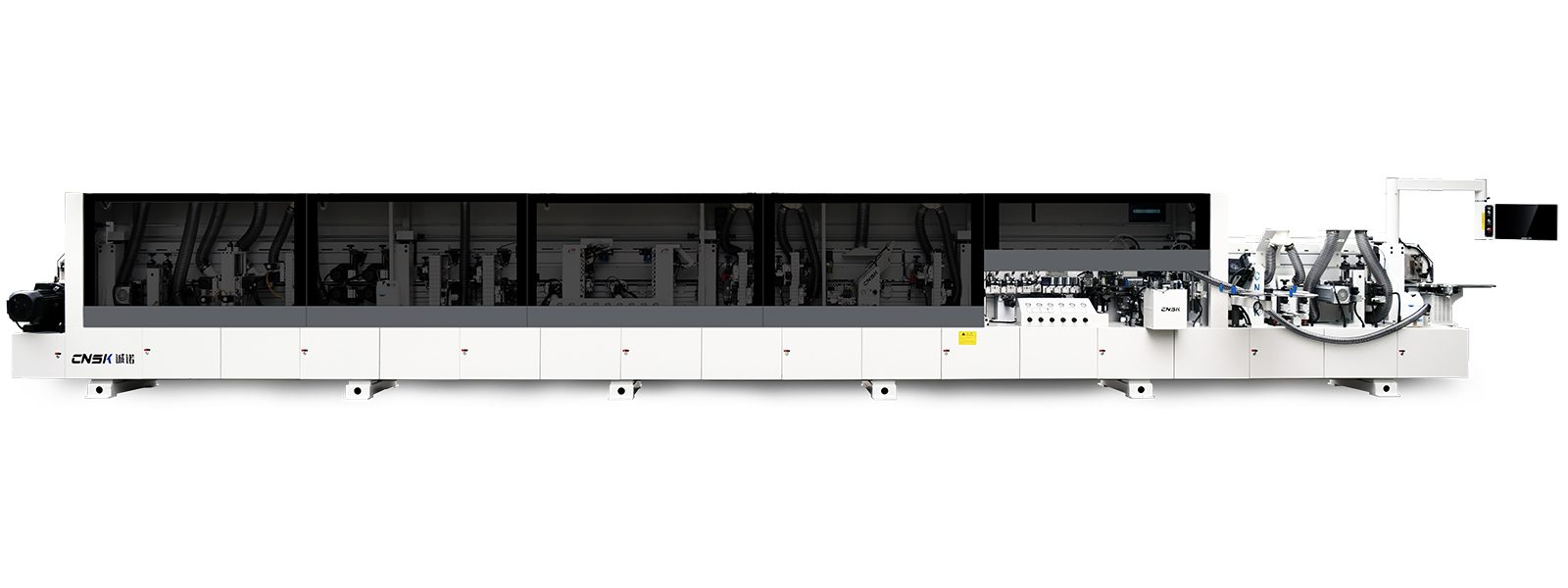
Skeleton-Line Grille Edge Bander
Skeleton-line doors, grille slats and standard straight edge banding on one track-fed 13-metre bed.
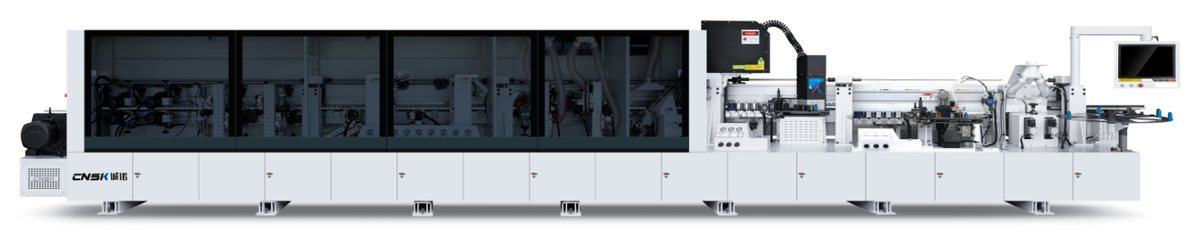
Intelligent laser edge banding machine
Fourteen cells on a 10.1 m frame: two-colour PUR pot, laser unit with cooling, four-head tracking and double polishing, at 22.5 kW.

Intelligent laser edge banding machine
Sixteen cells: EVA furnace and two-colour PUR pot ahead of the laser unit, then double scraping and two polishing heads, at 22.5 kW.
Put Laser830 Plus 45° Straight - bevel Edging against your panel.
Send the thickness, width and band you run. You get a station list, the tooling and a price against your name.